Sacred monuments in Kupljenik
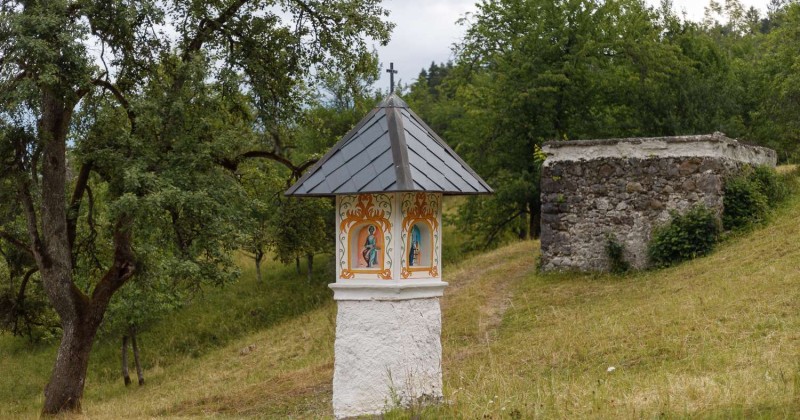
Shrines are small sacral structures that are frequently located at crossroads. Although they
are similar in appearance from the outside, they differ in purpose and their patron.
THE KUPLJENIK TRAIL
Welcome in the village of Kupljenik. In the village there is a church of St. Stephen, which is probably much older than previously thought (16th century). The path offers beautiful views of the Bled surroundings. Due to its long age, the village fascinates with a wonderful typology of old farms, while on the way you can see, the stone "dry wall", the cultural landscape and local heritage.
 Anton Padovanski
THE SHRINE OF MARY HELP
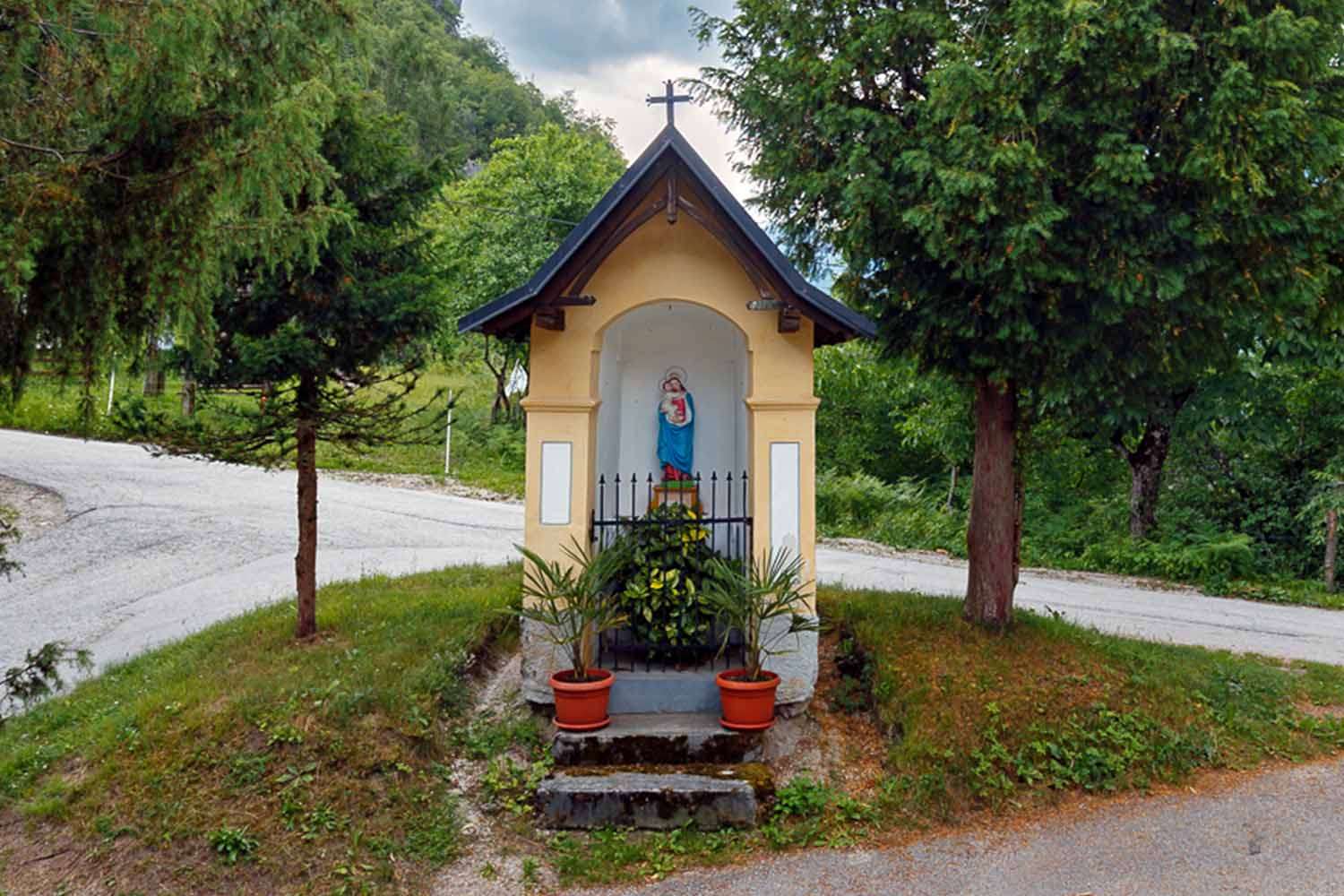
The wayside shrine marks the starting point of the Kupljenik village. Its side and rear walls are visible from the main road since at the time of its construction, the road still ran on the other side. The shrine is a partially enclosed structure housing a statue of Mary Help of Christians. First mentioned in the parish chronicle in 1898, the shrine was erected sometime after 1884. In 1997 it was completely renovated and blessed.
 The shrine of Mary Help
THE FRESCO OF ST. FLORIAN ON THE KUPLJENIK FIREFIGHTERS’ HOME
Ciril Rozman, a painter from Jereka in Bohinj, created a fresco of St. Florian, the patron saint of firefighters, on the façade of the Kupljenik Firefighters’ Home. The fresco was unveiled in 2011, marking the 100th anniversary of the local firefighters’ society.
THE CRUCIFIX AT PR’BRSU (HOUSE NAME)
The crucifix was erected by the priest Alojzij Rožič near his birthplace, on a small rocky outcrop reminiscent in shape of the rock of Golgotha. Low and set directly into the rock, the wooden structure of the crucifix has been renovated several times over the years. In the past, it stood along the route of both rogation and funeral processions.
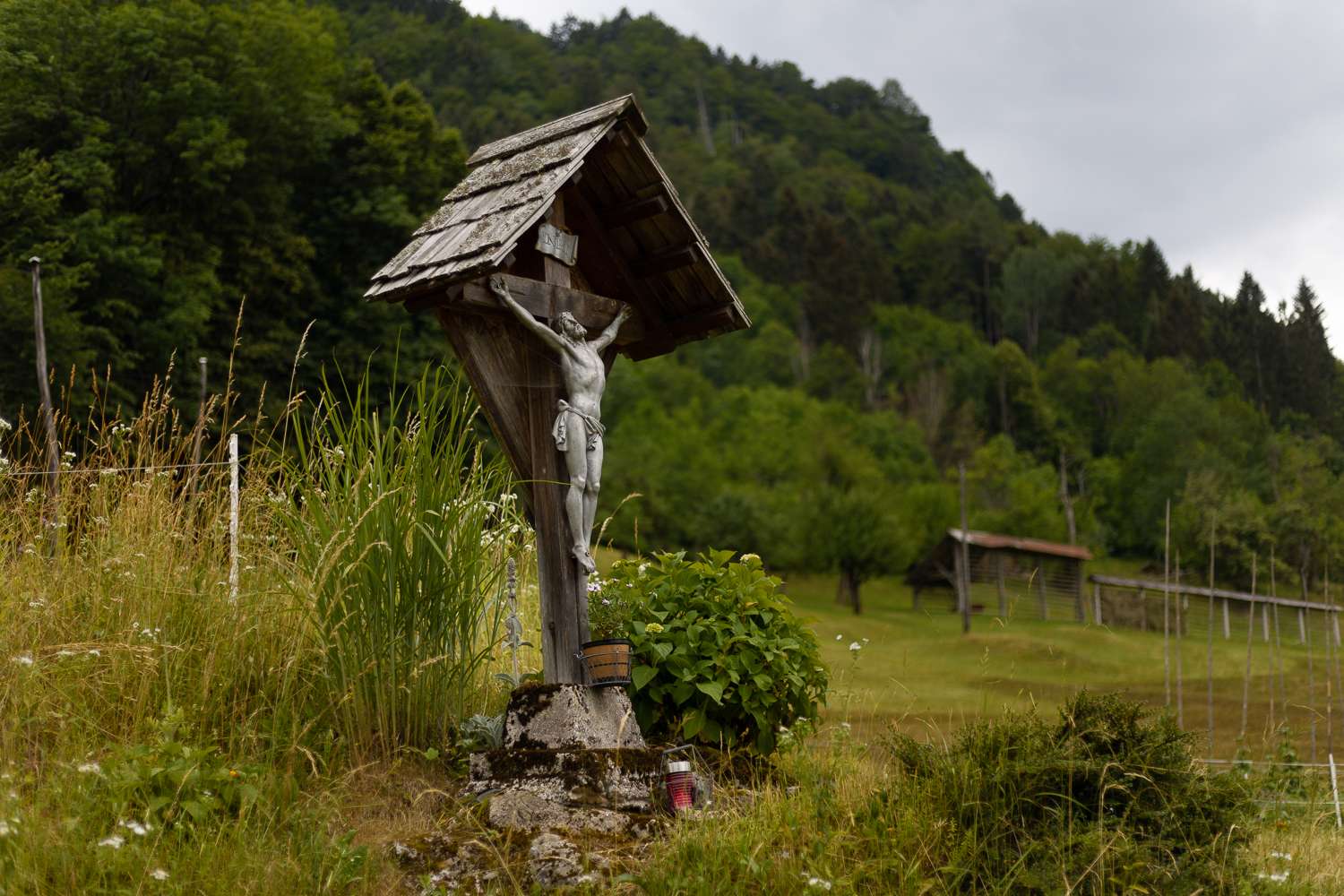 The crucifix at Pr’Brsu
BRSOV’S COLUMN SHRINE BELOW THE OBLAK FARM
This is the second-oldest preserved shrine in the Municipality of Bled. It is said to have been erected around 1684 by the owner of the large Kupljenik farm Pr’ Brsu, which also gave the shrine its name (Brsov is the possessive form of the family name). The shrine was built on a plot of land belonging to the family and stood at the meeting point of three farms.
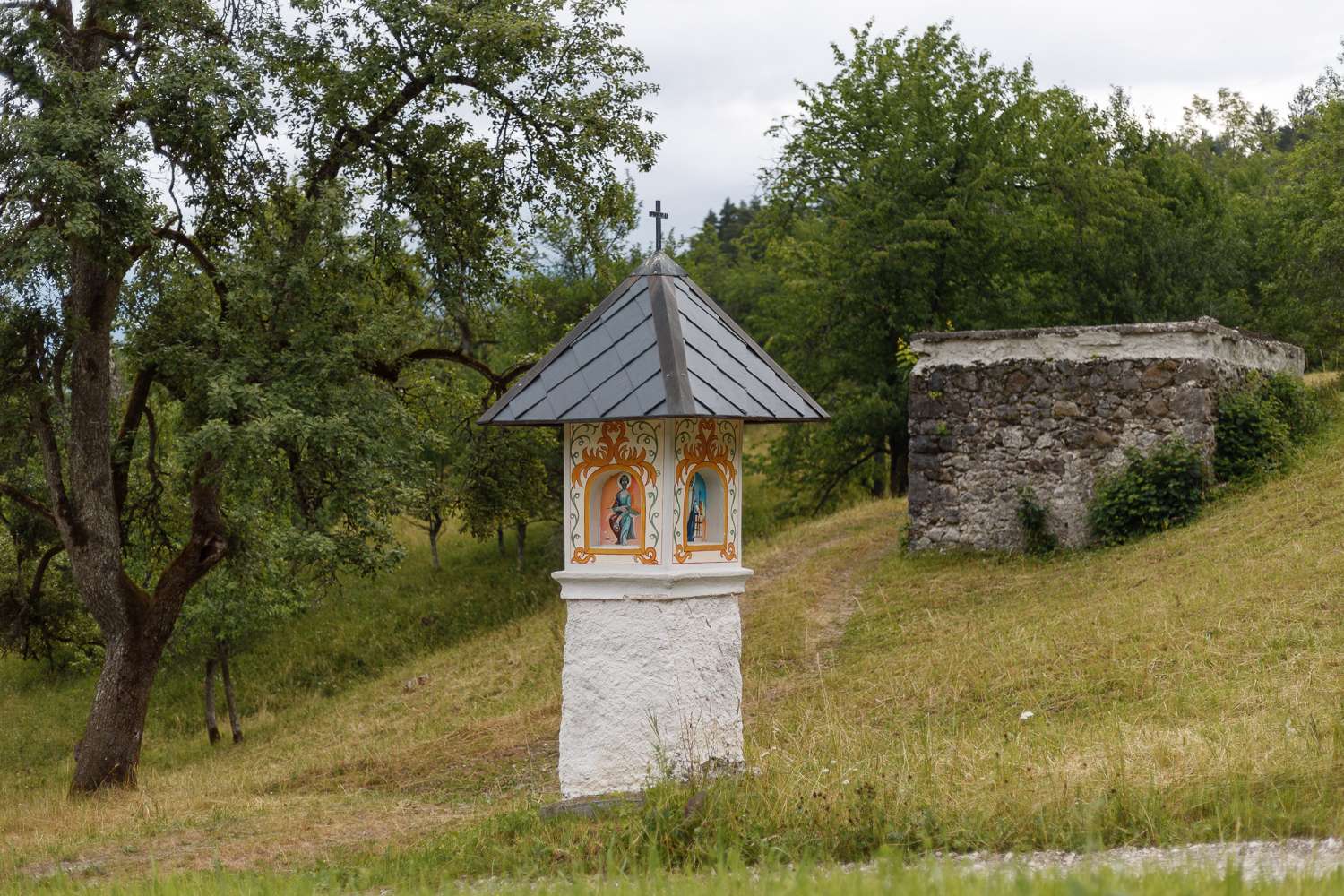 Brsov’s column
THE SHRINE AT KOREN
The small chapel can be found along the footpath from Selo via Koren to Kupljenik, perched on a rocky edge that offers spectacular views of the Sava Bohinjka River, Bled, and the surrounding villages and hills. It was most likely originally erected as a wayside shrine along the path to the pilgrim church of St. Stephen in Kupljenik. The masonry structure was built in the 1850s, as evidenced by the inscription 1857 carved into a metal railing, and a wooden crucifix was placed inside. After the Second World War, the shrine fell into disrepair. Its reconstruction began in 2004 and was completed with a blessing in 2006. The artwork inside the shrine was created by academic painter Maša Bersan Mašuk. The interior wall features a fresco of St. Sebastian, the patron saint of the village of Selo, while the front wall depicts St. Valentine, the patron saint and intercessor of the villagers of Kupljenik.
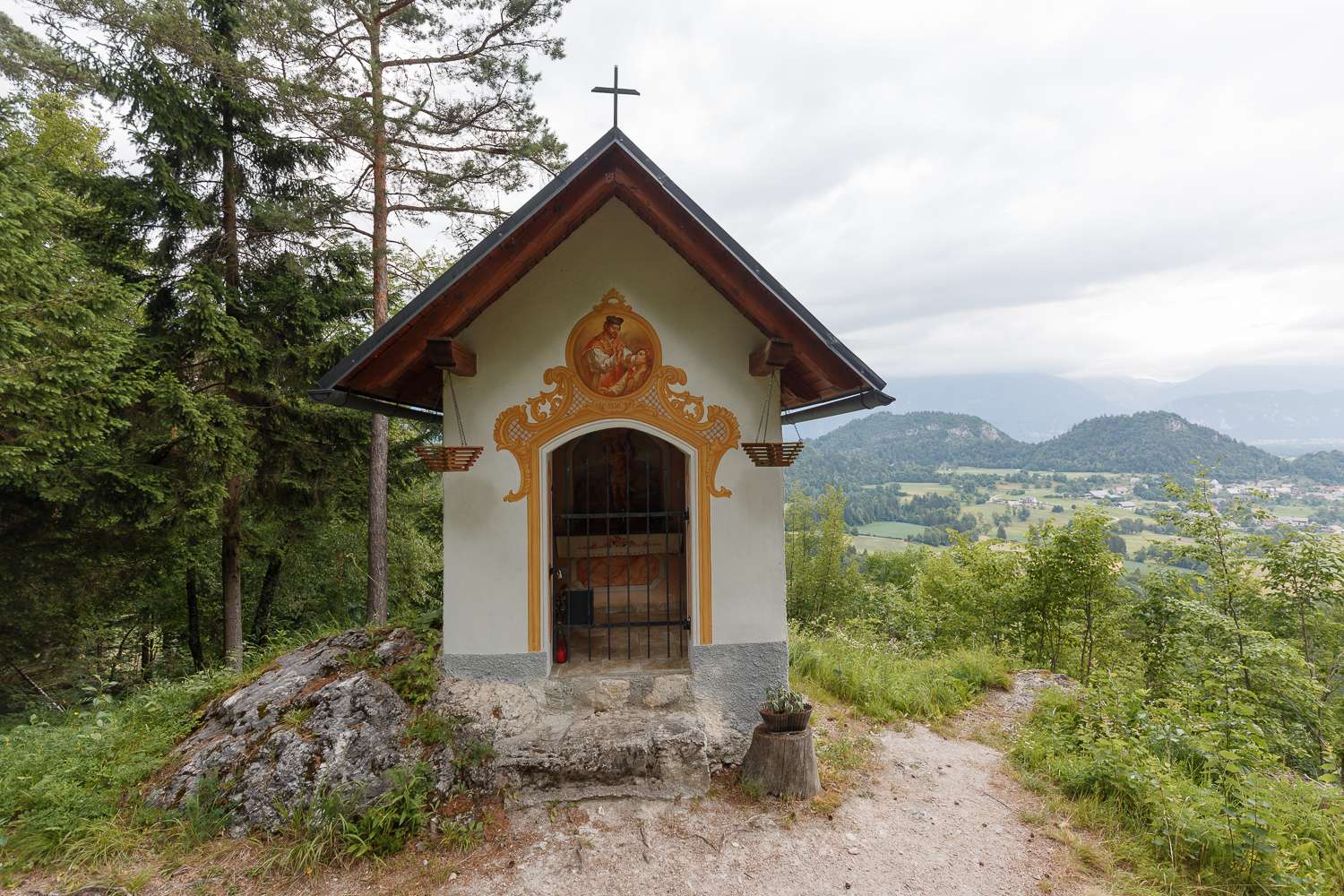 The shrine at Koren
ST. ANTHONY OF PADUA
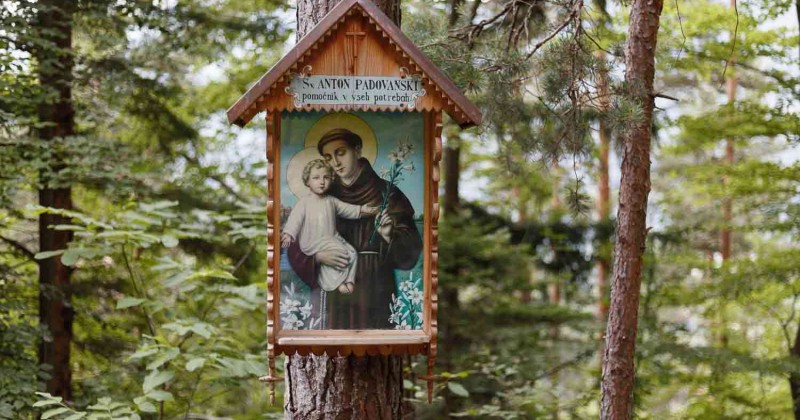
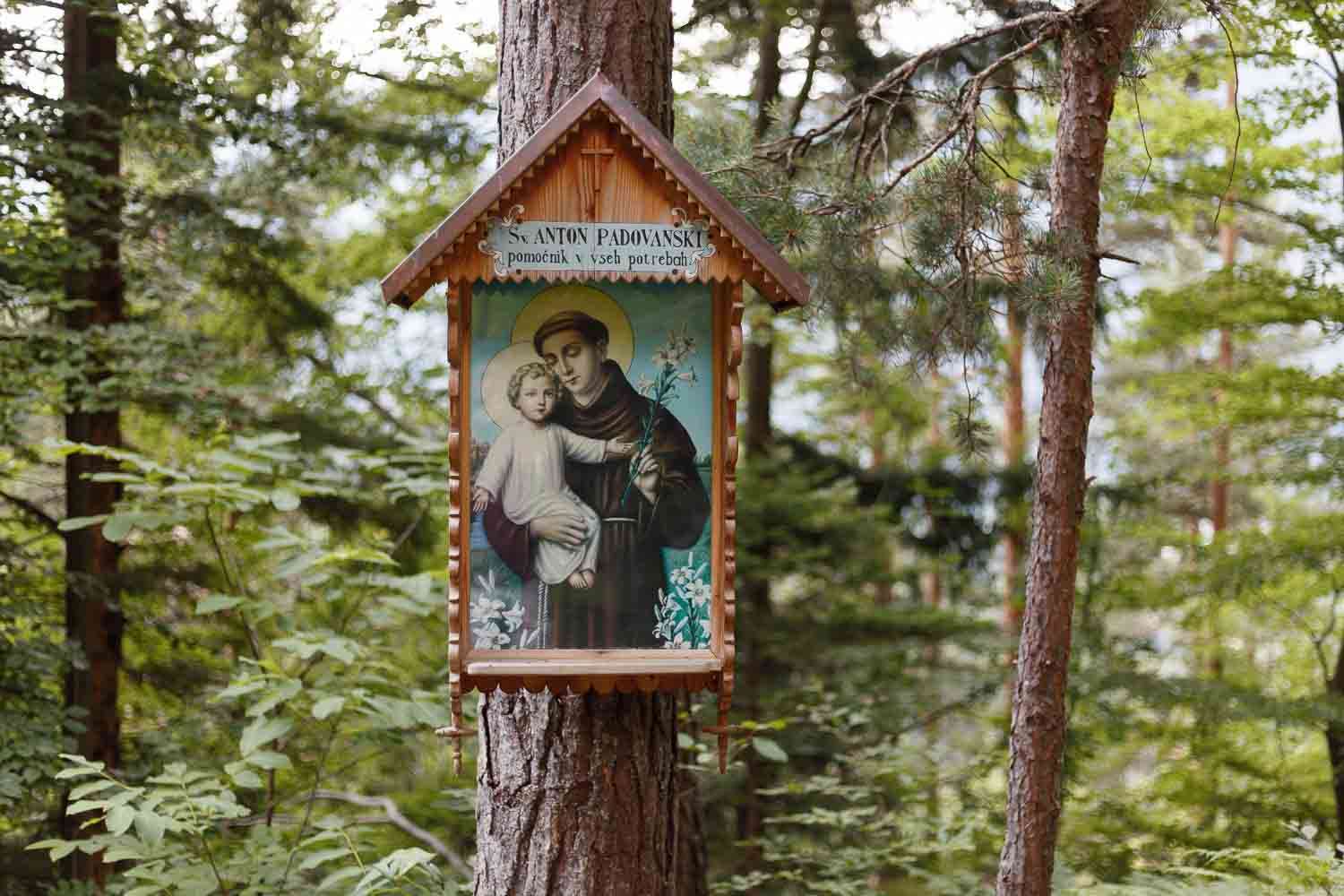
A simple shrine is attached to a tree, featuring a wooden frame with an image of St. Anthony of Padua. The inscription reads: “St. Anthony of Padua, intercessor in all needs.”
St. Anthony
Source: oral sources, Alojzija Habjan, Davorin Bernard, chronicles of the Bohinjska Bela parish.
WOULD YOU LIKE TO KNOW MORE?
We can separate shrines into those that were erected by grateful individuals who by setting up a shrine expressed their gratitude for a safe return from the army or a journey, or for recovering from an illness. An example of such a shrine is the shrine Kunščeva kapelica at Podroje. The shrine is placed in a rock cave and contains a statue of Our Lady of Lourdes. The second type is a valedictory shrine erected following the death of a parishioner. Other examples of such shrines are the Rajh shrine or the shrine at Breg, as well as the Bjovov shrine in the middle of the village. Since parishioners were buried in a coffin, the pallbearers brought the deceased in the coffin to the shrine, whereupon the priest met the deceased and the undertakers and the procession continued to the church. The third purpose of such shrines is to mark pilgrimage routes as they are usually located at the crossroads of the paths and are dedicated to Mary.
THE SHRINE OF MARY HELP OF CHRISTIANS
The wayside shrine marks the starting point of the Kupljenik village. Its side and rear walls are visible from the main road since at the time of its construction, the road still ran on the other side. The shrine is a partially enclosed structure housing a statue of Mary Help of Christians. First mentioned in the parish chronicle in 1898, the shrine was erected sometime after 1884. In 1997 it was completely renovated and blessed.
The chronicle mentions the shrine in an entry from 1898, describing a rogation procession. Before that year, the procession began at the shrine at the entrance to the village; 1898 was the first year when it started from the parish church in Bohinjska Bela. The villagers would meet the procession at the shrine and join in, carrying two beautifully decorated lanterns. Rogation processions continued along this route until 1946.
According to oral tradition, the construction of the shrine was financed with money the villagers earned in return for digging the path from Kupljenik over Gradišče to the cave below Babji zob. The path was funded by Petran, a hotel owner from the nearby village of Mlino, who organize guided tours to the cave. The shrine underwent a thorough renovation in 1997, funded by current and former inhabitants of Kupljenik. The renovated shrine was blessed by Anton Jakoš, the priest of Bohinjska Bela. The shrine is said to have replaced an earlier crucifix.
The site, with its crucifix and shrine, was a place where farewell services were held for the deceased from the first part of the village. The locals performed a special ritual they called “Asking Forgiveness.” Relatives of the deceased would ask a designated person to request forgiveness on behalf of the departed: if the deceased was male, the role was taken by a man; if female, by a woman. The last person known to perform this role for both men and women was Minka Ropret, vulgo Mašišnek. The plea for forgiveness went as follows: “I, in the name of the late [name of the deceased], on behalf of the family, neighbors, friends, acquaintances, and all gathered here, humbly ask that if the departed has ever wronged, offended, or hurt you in any way, you may graciously forgive and forget — if for no other reason, then for the sake of the five holy wounds of Christ.”
After the plea, the Our Father and Hail Mary were recited. At the conclusion of the ceremony, the closest relatives sprinkled holy water on the coffin. The family who lived nearest to the shrine, the Cucek family, were responsible for preparing the shrine, placing candles and holy water, and decorating it for the occasion.
THE FRESCO OF ST. FLORIAN ON THE KUPLJENIK FIREFIGHTERS’ HOME
Ciril Rozman, a painter from Jereka in Bohinj, created a fresco of St. Florian, the patron saint of firefighters, on the façade of the Kupljenik Firefighters’ Home. The fresco was unveiled in 2011, marking the 100th anniversary of the local firefighters’ society.
To celebrate 100 years of operation, the Kupljenik Firefighters’ Society renovated the Firefighters’ Home and commissioned the fresco. Rozman, an amateur painter, completed the artwork, and the renovated building, along with the fresco, was blessed by the parish priest of Bohinjska Bela at the time, Roman Kušar.
THE CRUCIFIX AT PR’ BRSU
The crucifix was erected by the priest Alojzij Rožič near his birthplace, on a small rocky outcrop reminiscent in shape of the rock of Golgotha. Low and set directly into the rock, the wooden structure of the crucifix has been renovated several times over the years. In the past, it stood along the route of both rogation and funeral processions.
Alojzij Rožič was born on 18 June 1840 on the Pr’ Brsu farm in Kupljenik. He was the first priest to celebrate his first Holy Mass in Bohinjska Bela, in 1864. Rožič served as a curate in the Bled parish and in several other towns in Gorenjska. His final posting was in Krašnja, the home parish of Martin Drolc, the long-standing priest of Bohinjska Bela. In poor health, Rožič later withdrew to the monastery in Škofja Loka, where he died on 28 September 1906. He is buried in the Škofja Loka cemetery.
BRSOV’S COLUMN SHRINE BELOW THE OBLAK FARM
This is the second-oldest preserved shrine in the Municipality of Bled. It is said to have been erected around 1684 by the owner of the large Kupljenik farm Pr’ Brsu, which also gave the shrine its name (Brsov is the possessive form of the family name). The shrine was built on a plot of land belonging to the family and stood at the meeting point of three farms.
The shrine underwent a thorough renovation in 1998. The work was led and supervised by the Kranj branch of the Institute for the Protection of Cultural Heritage, under the expert guidance of Nika Leban. The shrine had to be leveled, and its foundations repaired. The construction work was carried out by Miha Pelko from Ribno, while the restoration of the paintings –including paint stripping and repainting – was done by academic painter Anton Marolt. The ornaments the shrine’s walls have been restored but the niches were newly painted since the originals were too damaged to determine their content. The new images include: St. Stephen in the western niche, St. Florian in the northern niche, Mary, Mother of God, in the eastern niche, and St. Lawrence in the southern niche. The roof renovation was completed by two local craftsmen: Alojz Razinger, vulgo Rožičev, and Anton Strgar, vulgo Jagrov. In 2022, a slate roof was installed to replace wood shingles.
The renovated shrine was blessed by the parish priest of Bohinjska Bela, Roman Kušar, in the company of seminarian Janez Burja, vulgo Šnetov. The artistic and historical significance of the shrine was presented by art historian Cene Avguštin from Radovljica. The restoration was carried out by Boštjan Razinger, vulgo Rožičev, with the help of fellow villagers. The project was fully financed by the villagers of Kupljenik, who are very proud of this landmark.
The year of construction coincides with the enlargement of the church in Kupljenik. In 1684, a bell tower was added to the existing structure. The owner of the Pr’ Brsu farm asked the builders and artists to erect and decorate this shrine as well. At that time, the path to Kupljenik still led from Bled through the village of Selo and across Koren, and the column shrine was the first one in the village; today – as the road approaches from the opposite side, from the direction of Bohinjska Bela – it is the last. When Kupljenik was part of the Bled-Grad parish, where the villagers were also buried, the shrine likely served as the place of final farewell for the deceased villagers of Kupljenik. Later on, it became the farewell site for the residents of the other part of the village. The deceased were transported along the lower path across the fields, rather than through the village and past the church. Rogation processions also passed by this shrine.
During the renovation of the church in 2013, decorations identical to those on this shrine were discovered inside the church, confirming its age. The age was further verified by experts from the Institute for the Protection of Cultural Heritage.
THE SHRINE AT KOREN
The small chapel can be found along the footpath from Selo via Koren to Kupljenik, perched on a rocky edge that offers spectacular views of the Sava Bohinjka River, Bled, and the surrounding villages and hills. It was most likely originally erected as a wayside shrine along the path to the pilgrim church of St. Stephen in Kupljenik. The masonry structure was built in the 1850s, as evidenced by the inscription 1857 carved into a metal railing, and a wooden crucifix was placed inside. After the Second World War, the shrine fell into disrepair. Its reconstruction began in 2004 and was completed with a blessing in 2006. The artwork inside the shrine was created by academic painter Maša Bersan Mašuk. The interior wall features a fresco of St. Sebastian, the patron saint of the village of Selo, while the front wall depicts St. Valentine, the patron saint and intercessor of the villagers of Kupljenik.
A legend says there used to be a church at Koren. A military map dated 1763–1787 marks a shrine at this location. It is believed that the shrine was built in gratitude for the safe transport of materials for the church from Selo along the very steep and dangerous road over Koren to Kupljenik, using the money and materials left over after the completion of the church.
The shrine sits on a rock that was incorporated into the floor of the original structure. It is quite large, reportedly designed to accommodate the statues depicting the stoning of St. Stephen, which was supposed to be moved here from the church to make room for a new altar. However, this relocation never took place. Instead, the shrine received a one-meter-high crucifix. After the Second World War, an officer from the Bohinjska Bela barracks removed it and threw it over the rocky edge below the shrine. Village children grazing their cattle later found it hanging from a beech tree beneath. Because the crucifix was badly damaged, they had it restored by master Barbič in Bohinjska Bela. Once repaired, it was installed in the church in Kupljenik, where it still stands, and it continued to be used during the May rogation processions. Later, various pious paintings were placed inside to replace the crucifix, but these too were soon removed and thrown over the rock. The family entrusted with the shrine’s upkeep was the Oblak family, primarily Oblakova Tona (Antonija Zupan). Following the post-war desecration, the shrine was no longer maintained and fell into disrepair. The roof and arch collapsed, the walls began to crumble, and the structure became so overgrown with bushes that it was barely visible from the path.
After Slovenia gained independence, the villagers decided to renew all the shrines in Kupljenik. In 2004, it was time this shrine’s turn to be restored. First, the area was cleared of bushes and trees. The following year, work continued with the renovation of the walls, arch, and roof. The masonry work was carried out by Anton Razinger (vulgo Rožičev Tonej), with the help of Vinko Frelih and Jože Poljanec from Selo. Rudi Šmid applied a fresh coat of paint, while Alojz and Boštjan Razinger (vulgo Rožičev) took care of the carpentry. The artwork was created by academic painter Maša Bersan Mašuk, a Russian artist currently living in Ljubno.
The painting on the interior wall depicts St. Sebastian, the patron saint of Selo. According to oral tradition, the people of Selo prayed to St. Sebastian during a hard time when many small children from their village died. St. Sebastian’s intercession is also documented in the village chronicle and in a book by Vladimir Silič. The fresco of St. Sebastian includes a dove as a symbol of the Holy Spirit.
The front wall’s gable is decorated with a fresco of St. Valentine of Passau, a bishop celebrated on 7 January. The patron saint and intercessor for the villagers of Kupljenik, St. Sebastian was likely chosen because he is traditionally regarded as a protector of cattle, similar to St. Stephen, the patron saint of the Kupljenik church.
The renovation of the shrine was financed by the villagers, the agrarian communities of Kupljenik and Selo, the Municipality of Bled, and Danica Šlibar (vulgo Hruminčeva) from Selo, who owns the land on which the shrine stands. The shrine was blessed on the last Sunday in August 2006 by Roman Kušar, the then parish priest of Bohinjska Bela. The blessing was attended by seminarian Luka Demšar from Ribno and the church choir from Bohinjska Bela. The cultural program featured performances by Rado Mužan from Ribno, Anton Šlibar from Selo, and Lojze Ropret from Bohinjska Bela. Also present were the mayor of Bled, Jože Antonič, and the president of the Bohinjska Bela Community, Anton Kristan. The shrine and the renovation project were presented by Karol Primožič. The blessing coincided with the anniversary of the Village Women’s Association of the Bled-Gorje municipality. The local ensemble Bevski Oltajmerji provided the musical accompaniment, and the Kupljenik Firefighters’ Society supplied refreshments.
Thanks to its position, views, and convenient location along the footpath, the shrine is very popular. Some visitors stop only briefly, while others linger to enjoy its peaceful atmosphere.
ST. ANTHONY OF PADUA
A simple shrine is attached to a tree, featuring a wooden frame with an image of St. Anthony of Padua. The inscription reads: “St. Anthony of Padua, intercessor in all needs.”
The shrine stands along the path leading from Na kraju toward Martinca. According to the elders, this spot receives sunlight throughout the year. The village of Kupljenik, situated on the shady side of the Jelovica plateau, gets virtually no sun during winter, which made this sunny spot especially cherished by the locals during the colder months. People would come here to pray, mostly on Sunday afternoons. A simple bench used to stand near the shrine providing a place for rest and reflection.
Over time, the spruce that supported the shrine was destroyed by bark beetles, and the wooden frame had worn out. The shrine was renovated in 2019: the new wooden frame was made by Klemen Razinger, the inscription refreshed by Metka Burja, and the new painting was donated by Nežka Savernik-Cuckova, who now resides in Naklo. The renovated shrine was blessed by the parish priest of Bohinjska Bela, Roman Kušar.
THEY NO LONGER EXIST
THE STATUE OF OUR LADY AT MAŠIŠNEK FARM
The interior of the house at Kupljenik 5 (not open to the public) contains a rare treasure: a beautiful statue of Our Lady. The statue was purchased by Jožef Ropret, vulgo Mašišnekov, in gratitude for his safe return from the First World War. He had vowed that if he survived the war, he would build a chapel by his house. Unfortunately, the purchase of the statue was all he could manage.
THE ROŽIČ SHRINE
The shrine was built around 1890 by the owner of the Rožič farm. It stood at the crossing of the lower footpath through the village and the path leading to the farm. The shrine was a simple totem fitted with a roofed wooden frame and contained a painting. In the 1950s, the wooden totem had rotted, the shrine collapsed, and the owner did not repair it. In the past, the rogation procession in Kupljenik passed by this shrine, and the deceased from the rear part of the village were carried past it on their final journey.
OUR LADY OF LOURDES IN THE CAVE BELOW BABJI ZOB
The village elders still remember a 30 cm-high porcelain statue of Our Lady of Lourdes that was placed among the stalactites in the cave below Babji zob. Alojzija Habjan, vulgo Oblakova, believes the statue was most likely brought to the cave by Jožef Ropret, vulgo Mašišnekov, who served as the cave guide before and after the First World War. Visitors to the cave would often stop at the statue, some to pray or sing. After the Second World War, the statue was removed, though there is no record of who removed it or exactly when.
Source: oral sources, Alojzija Habjan, Davorin Bernard, chronicles of the Bohinjska Bela parish.